I got a job and have a lot of feelings about it
“I saw you got a full-time offer. Congrats?”
The people who know me well were the ones who included a question mark with their congratulations. They are spot on. The question mark is exactly how I feel about the whole thing.
I came home from Hawaii tan, rested, and connected with the ocean, and got hit in the face with a full-time offer from the company I’d been contracting with. The catch: GTM Architect, a job I’ve never done before (GTM = go-to-market). The gist is working with companies to implement their GTM operations infrastructure and technology. I’ve never worked in a GTM organization before — what even is a GTM organization? I know how to log into Salesforce and that’s pretty much it.
I was hesitant to say yes because it felt like a trap. I wanted to make sure we were aligned on expectations — like, if you think I have experience in any of this, you are sorely mistaken — and that I would actually be set up for success. The CEO booked time on my calendar to “close” me. (Nothing like a sales call about your own employment.)
He told me that I already do the hard stuff: the stakeholder management, the clear communication, the relationship-building, the “executive presence” (yuck, I hate that term, but I understood what he meant). The team is committed to ramping me up on the technical stuff. He admitted that people who have all the GTM experience and technical skills are not always good at this job, because it’s the people stuff that can be difficult.
To be honest, that was validating and reassuring and made me feel so good about myself. They realized that the “soft skills” I’m good at are… well, skills, and skills that are more difficult for them to teach. Perhaps for the first time in my career, a company saw me for my potential and not just what I’d already done. And I’m not even a white man!

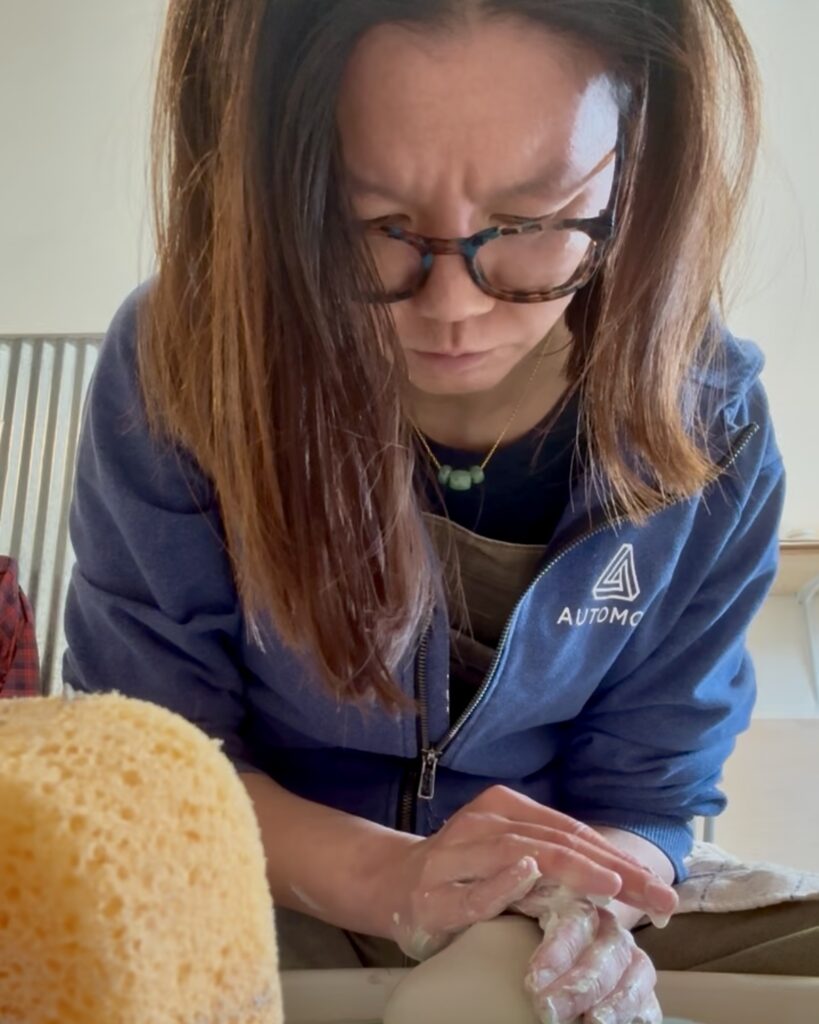
The last year and change had been genuinely amazing. Turns out not being on the late-stage capitalism hamster wheel does wonders for your mental health — who knew? I loved the freedom to do what I wanted, and to not have anyone have control over my time. I loved waking up to decide I wanted to spend the entire afternoon in the pottery studio, being glued to the wheel and not a screen, with nowhere else to be.
What I didn’t love was being broke. I was moving money around from savings and living paycheck to paycheck in a way I’d never done before, because wow, bills are expensive and they do not care about your personal growth arc.
Truly, one of my first questions when I got the offer was: “what does this mean for my studio time?” Which tells you everything about who I’ve become over the last year. Which also made me a little afraid of who I’m about to become again.
Part of me thought accepting this job would contradict — set back, even — everything I’ve been trying to do in the design of my life. I’ve been writing about my freedom and rediscovery of myself and everything important to me, and how my nervous system is finally in a stable place, and how I have time to create art with no pressure from anyone but myself. Working a 9-5 again goes against much of that.
I originally wrote “takes away,” but I backspaced the hell out of it. I think the only thing I lose is time, if I do this right. But that’s a big if. And it has a smaller, meaner question underneath it: will I do this right?
It’s easy to talk myself into why this is great. A full-time job is really all I’d ever known until recently. It’s familiar. It comes with a regular paycheck and health insurance — and after R’s unexpected eye surgeries, plural, having actual insurance that will cover an emergency is not nothing. (It is, in fact, a lot.) The company is small, I like the people, and I will not pretend the idea of a bi-monthly paycheck didn’t make me exhale in a way I hadn’t in a while. (Side note: the word bi-monthly is ridiculous. In this case, it’s 2x a month.)
But I’ve also learned that a full-time job is not safe. It gives the illusion of safety. They could decide they don’t want to employ me anymore, for any reason. That hasn’t changed.
And if I’m being really honest with myself, what scares me more than getting laid off is getting so deep in it that I lose the plot.
For starters, I’ve already googled basic GTM things. Things I probably should have known before saying yes, though I think I’ve done a decent job of making them believe I know them. I also may have asked Claude to explain RevOps to me like I was five. The “I know how to log into Salesforce” bar is even lower than I made it sound.
And an underlying fear is that saying yes makes me a hypocrite. Or worse, a failure. Like I couldn’t actually make it work any other way, and the full-time job was always going to be the ending, and everything I wrote this year was just a very long way of arriving back where I started. I don’t fully believe that, but I believed it for like 45 minutes while I was spiraling, so I’m including it for accuracy.
The thing I’m actually really scared of is the nervous system response to an unexpected Slack message, or a terse comment on a call, that sends my body into full threat-response mode — heart rate up, jaw tight, that flavor of dread that makes no evolutionary sense because it is a frickin Slack message, Amanda — as if I’m being stalked by a tiger and not pinged by a coworker about a deck. I spent a year getting that response to quiet down. I do not want it back.
That’s the real loss I’m calculating. Not the time, exactly, though that is a loss I’m grieving. But the nervous system.
The question mark in “Congrats?” isn’t pessimism. It’s my friends knowing me well enough to understand that I don’t experience things cleanly. I said yes to the offer. I think it was the right call, or at least a reasonable one, or at least the one I made.
I had to remind myself that nothing is permanent. This is my reality until it isn’t. I could leave if it sucks. Past Amanda would have never considered quitting an option. Past Amanda would have ground it out and called it resilience.
The question mark stays.
Leave a Reply