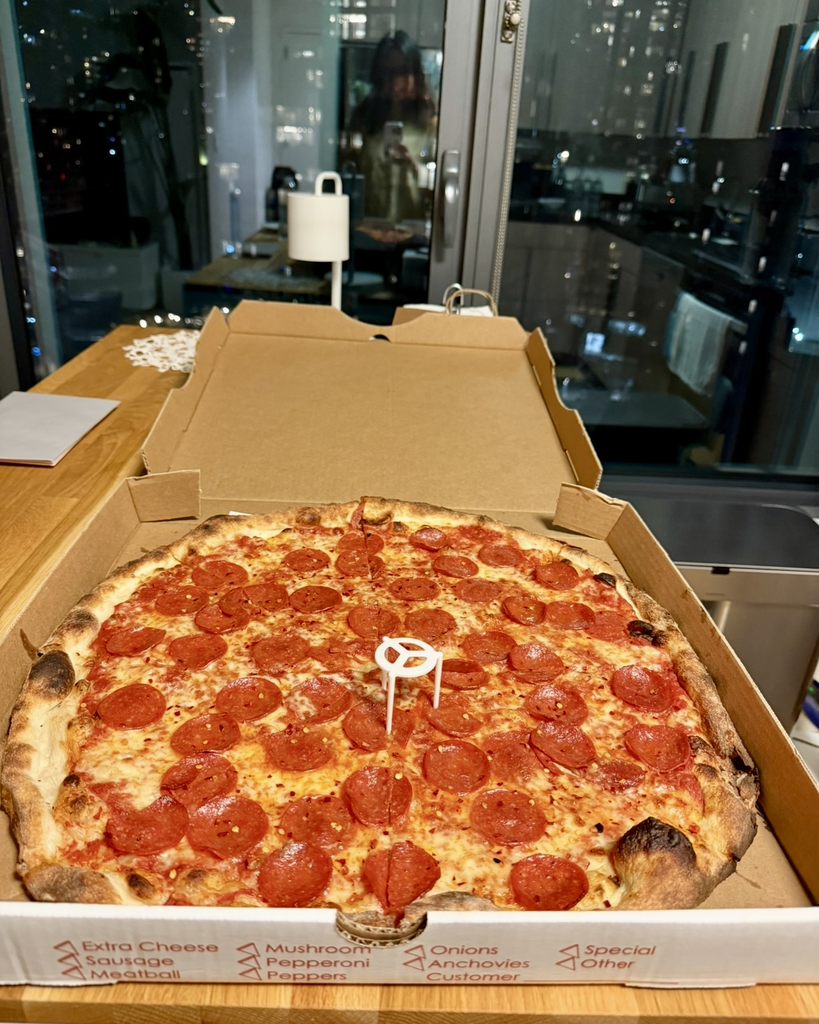
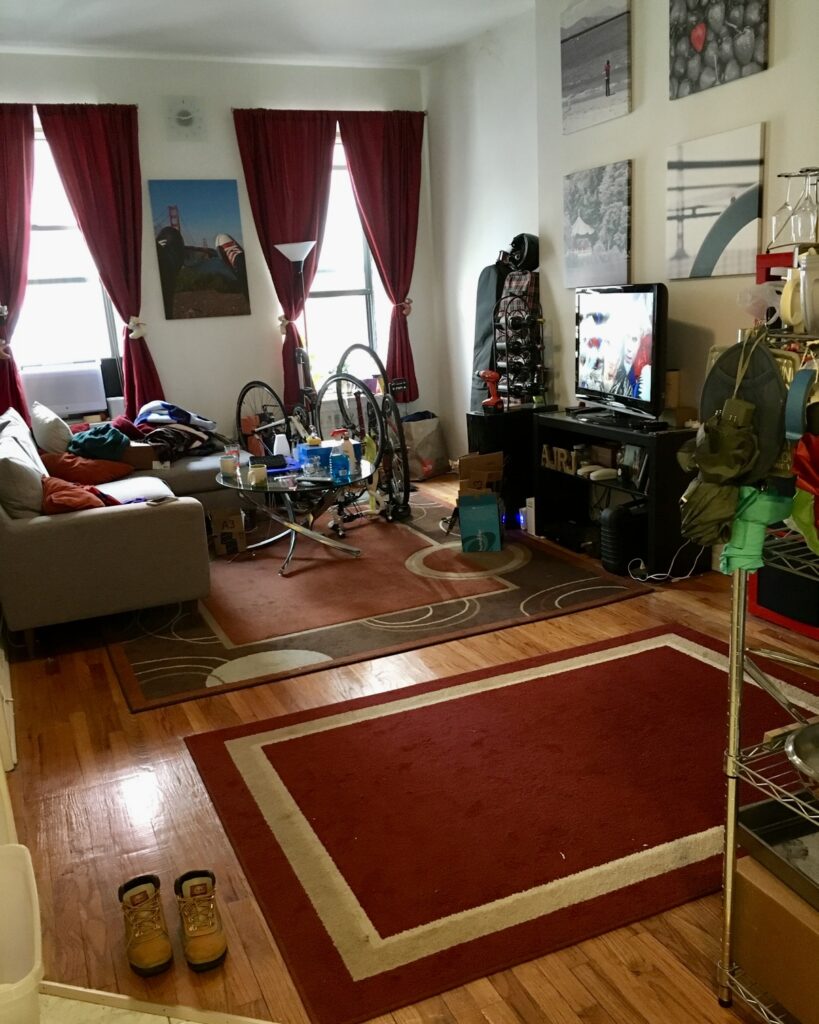
We’d just gotten back to Brooklyn — with a large pepperoni pie from Joe’s, because we’d already had dinner and maybe one too many post-dinner drinks at a trendy wine bar (I’m keeping this recommendation to myself, sorry y’all), and a trip to New York means we get to have as many dinners as we want — and we were slow getting out of the Lyft. Mid-conversation, pizza box needing both hands, a little wine-tipsy, neither of us in a rush to be the first to get to the door.
A guy leaving the building exited from the swinging doors instead of the revolving one we were “supposed to” use. He yelled, “YO. Hurry up. I’m holding the door FOR YOU.” In a Brooklyn accent.
We hadn’t asked. We weren’t even in the “is someone close enough to hold the door for them” zone yet. He just saw two people heading his way with a pizza box the size of a manhole cover and yelled anyway.
None of this registered as rude. He may have yelled at us, or rather, in our direction, but I wasn’t offended. I found it refreshing. I think I’m a little homesick. I miss the hell out of the city.
always an appropriate second dinner
This is the “New Yorkers are kind but not nice, and Californians are nice but not kind” thing people love to say. Nice is a performance for the room. It’s the smile, the “have a good one,” the held door where you’re thanked and thank them back and everyone feels good. Nice is the customer service voice. Nice is the sales version of me.
I got a dose of “nice but not necessarily kind” during every post-layoff period. So many people said the same eight words — “let me know if you need anything!” — and meant them, I think, in the moment they typed them. But they didn’t specify what “anything” was allowed to be. And when I actually took a few of them up on it — hey, could you take a look at my resume, do you know anyone hiring, can you introduce me to this person — some of them just went quiet.
The people who actually did something didn’t ask first. A few of them wrote me LinkedIn recommendations without me requesting it. Others forwarded a job posting with “this made me think of you” and nothing else. But they were few and far between, way fewer than the “I’m so sorry! Let me know if there’s anything I can do!” messages.
When my dad died, it wasn’t the people with the nicest condolence texts who I remember the most — it’s the friends who organized meal deliveries for me from a local Denver restaurant group even though they lived in New York, and didn’t make me talk about it if I didn’t want to.
None of that was nice, exactly. I think nice would’ve waited to be asked.
We got back to our Brooklyn apartment, had a few slices of pizza while settling in for the evening with the latest episode of Ted Lasso, and I thought about that interaction that happened right outside. He held the door for two strangers and expressed his own irritation about it in real time, and I found that sincere and incredibly New York.
Nice offers and doesn’t follow through. Kind just does.
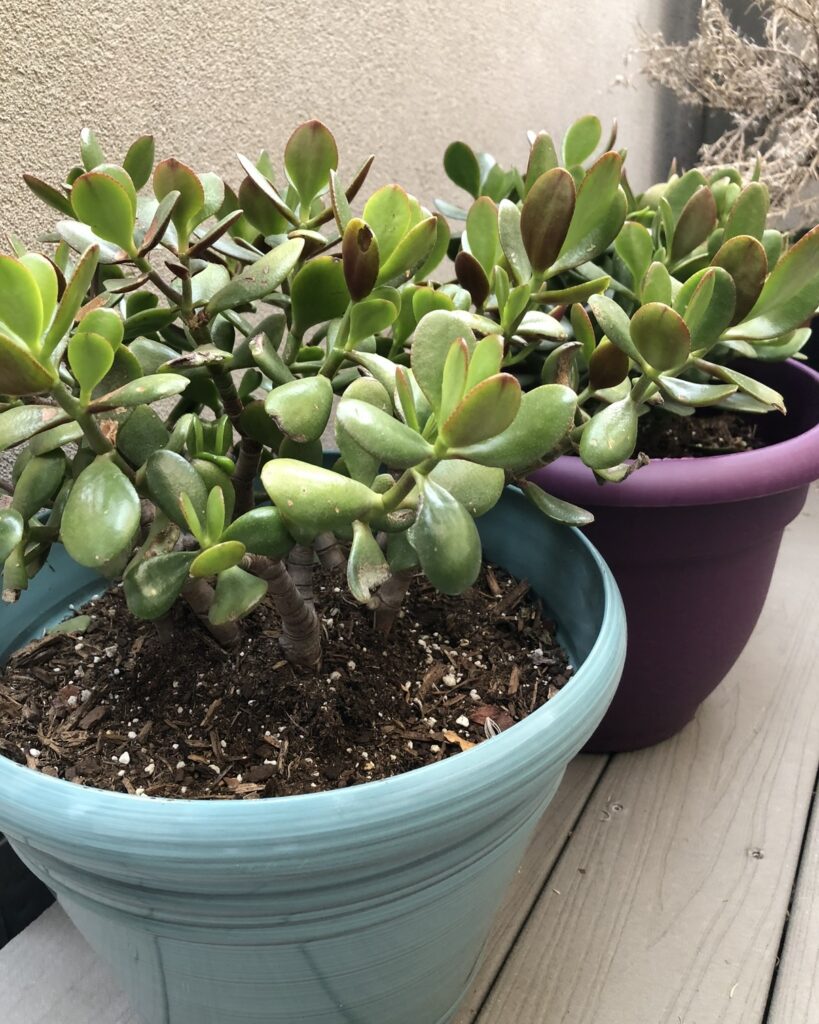
A few years ago, one of my jade plants had one branch that was clearly suffering and one that was clearly not. I called my mother-in-law about it because it was a good topic to talk to her about. I described my struggling houseplant over the phone like a very unqualified plant doctor giving a diagnosis: “this part is kind of shriveled and sad, this part’s fine, should I water it more?, should I water it less?, should I move it to a different window?”
And she just said, matter-of-factly: Cut it off.
“What? Just cut it off? The whole thing?”
“Yes. Cut it off.”
And so I did. It turns out there’s an actual biological (botanical?) reason it works like that. Cutting a main part of the plant doesn’t just remove growth — it redirects it. The plant sends its hormones sideways instead of up, and the side branches take over, and the plant ends up bushier and fuller than it would have been if you’d just left the whole thing alone. She wasn’t being poetic. She was just factual, and correct.
the happy jade plants
I have never been able to cut a plant back without wincing. Every leaf feels like a decision I can’t take back. Even the shriveled brown and yellow leaves that I very obviously need to remove. But I hear her voice every time: Cut it off. And so I do. And the plants do better after I remove the junk.
—
It would have been her birthday this week.
My father-in-law’s nickname for her was Jolly. It suited her — she was warm, and joyful, and caring in a way that showed up in what she did more than what she said.
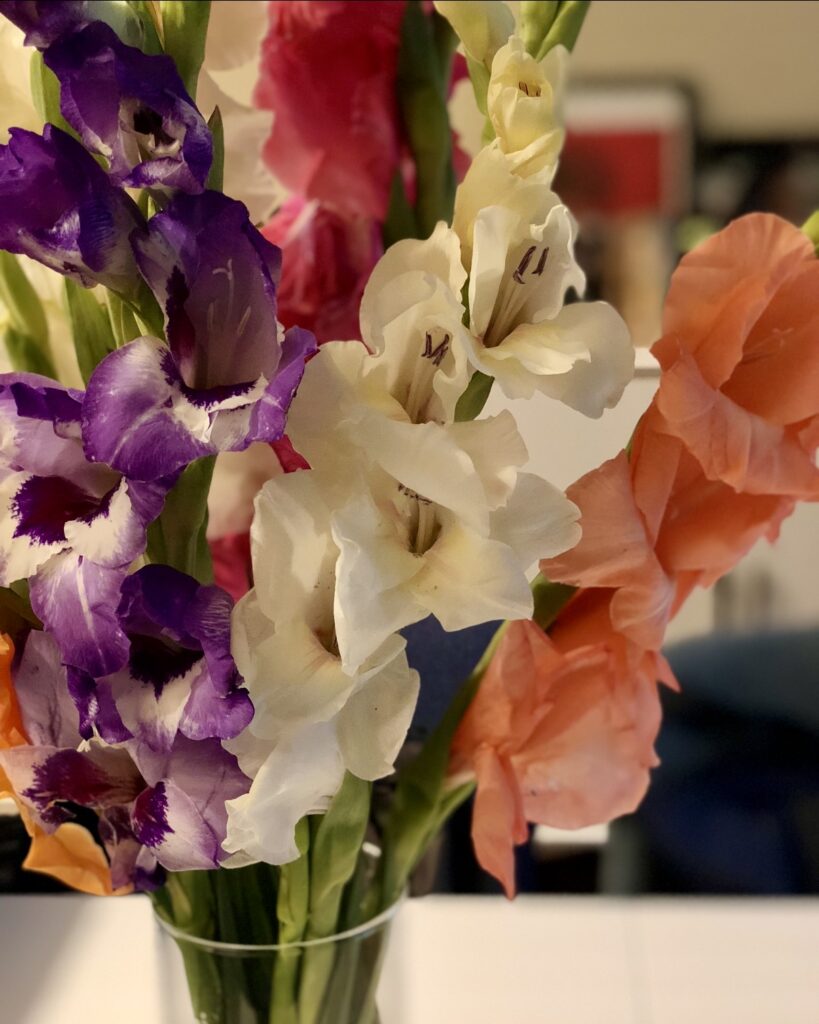
She visited us in Denver only once, in 2019. She bought me a bouquet from the farmers’ market that weekend — gladiolas. Tall, towering, vibrant gladiolas, in different colors. I never bought flowers for the house — in fact, I was always much more of a chocolate and candy girl than a flowers girl. But sharing something she loved — that’s how she showed love and care. I don’t know if she knew all about gladiolas and what they represent, or if she just thought they were pretty (they are soooo pretty). While doing some floral research for this essay, I learned that gladiolus literally means “little sword” and it represents strength and integrity… and that gladiolas are the birth flowers for August.
the gladiolas she bought. the only photo of gladiolas in my camera roll.
—
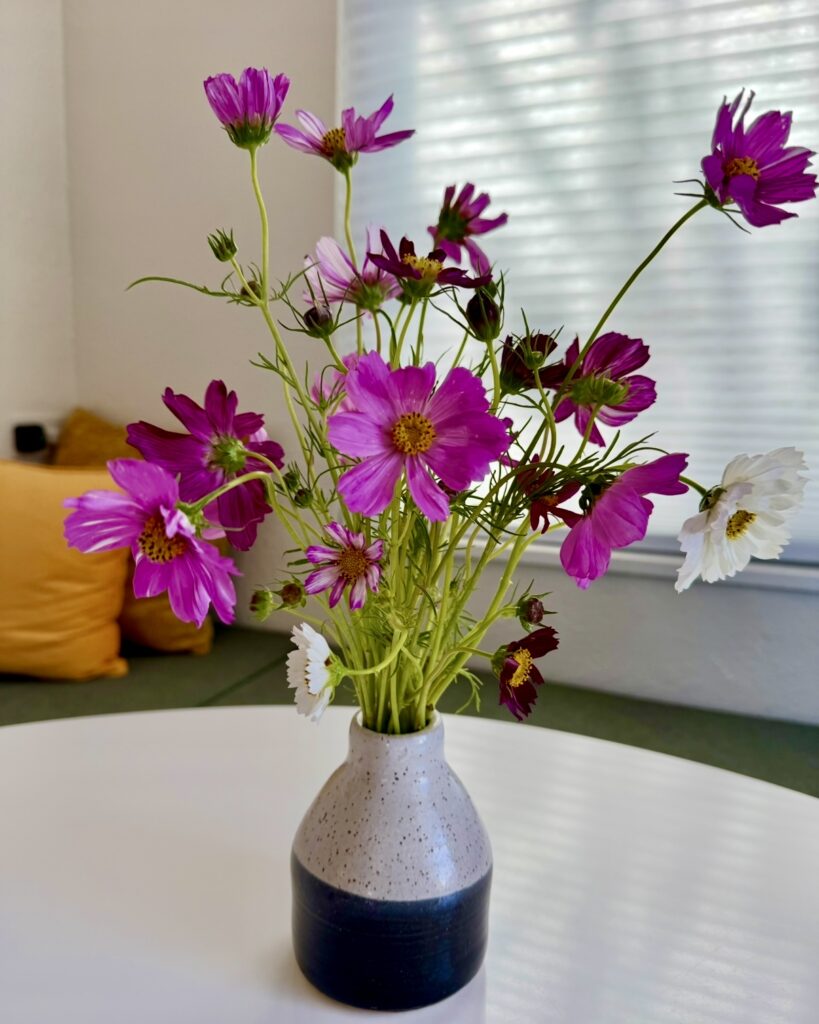
I buy a bouquet from the farmers’ market most weekends now. When I get home, I sit at the kitchen table and trim the stems before putting them in water and arranging them. And I think about her almost every time, not only because she loved flowers, but also the lesson she taught me. Cut it off. You’re supposed to cut the stems shorter so the flowers can drink. You have to take something away for the plant to survive.
cosmos: maybe my actual favorite flower, now that i regularly buy flowers
When something is not working, I’m learning to just cut it off instead of tending it like it’s the branch worth saving.
The jade plant came back fuller than it was before. Not just alive — but thriving. Unfortunately, it eventually succumbed to poor conditions (I put it outside without a transition and the sun fried it one day… oops). But it did survive, and thrive, because of my mother-in-law’s advice.
—
I haven’t seen gladiolas at the farmers’ market since. I don’t know if they were a seasonal fluke or the flower vendor that had them no longer appears at our market. But every week, I scan the buckets, hoping to find them.
Two months into physical therapy for the injury that wasn’t even caused by doing anything cool
I couldn’t tie my own bathing suit.
We were in Hawaii, and I was standing in front of the mirror in our hotel room trying to reach behind my back to knot a bikini top. And I couldn’t. My left arm couldn’t reach higher than the small of my back. I stood there a minute too long, considering whether I should do the little flip around and tie it from the front, or if I should just ask for help.
I asked for help. To the only person I ask for help. R helped me tie my top, and we were off to the beach. But for someone who was always able to scratch my own back, not being able to simply tie a bathing suit behind my back was troubling.
A few weeks earlier, I had woken up one morning not being able to fully raise my arm. I chalked it up to sleeping on it weird — which happens more than I’d like to admit. Like any other ache that magically appeared overnight, I’d give it a few days, stretch it out, and I’d be good as new(ish).
“A few days” came and went. I was still doing this weird half-shrug to reach the top shelf, still couldn’t get the arm all the way over my head, and I kept living in denial. You know this game if you’ve ever played it: it’s not that bad, it’s fine, I’ll mention it to a doctor eventually, definitely not worth a special appointment, especially without health insurance to pay for it.
A few days became a few weeks, and I felt myself getting more stiff. A few weeks led straight into our trip to Hawaii, and I was so bummed I hadn’t booked a surf lesson. One day, I stood on the beach doing the math — paddle out, pop up, catch a wave, all of it requiring an arm that currently could not reliably reach a bathing suit strap. I made the right call, but it didn’t make me any less sad about it. I was so sad about it that I didn’t even really talk about how sad I was about it, just sat there being fine. Being SO fine. Extremely fine, watching everyone else at Waikiki beach catch waves.
It took another few weeks after we got home before I stopped calling it a sleep thing and made an appointment to see a physical therapist — and only because PTs in the family urged me to. I did some internet research, as I do, and used LLMs to validate, and all those roads led me to either frozen shoulder or bicep tendinitis. The PTs I know couldn’t properly diagnose me through FaceTime without feeling how my shoulder moves. What good is having doctors in the family if I can’t get free medical treatment?!
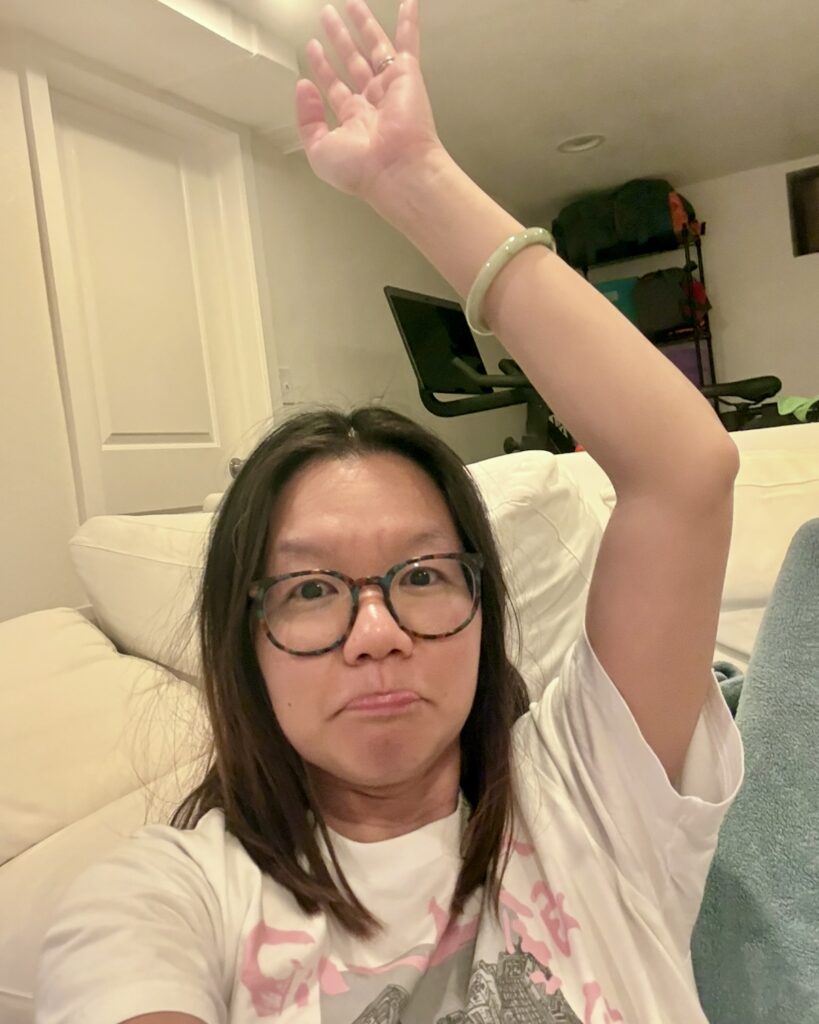
the photo i sent to my cousin who went to PT school
Anyway.
I met my physical therapist, Celina, and she made me demonstrate my range of motion. I didn’t want to lead the witness, so I didn’t mention a thing about frozen shoulder — only that I couldn’t fully move my shoulder. After talking through it with me, and, yes, feeling what my shoulder was like during movement, there it was: she asked me if I had ever heard of “frozen shoulder”. Well, technically “adhesive capsulitis,” which sounds so much worse somehow. There’s no clear cause. It just happens to you, mostly to women around my age, mostly for no reason anyone can really explain. It is a symptom of perimenopause, so… yay, as if women don’t have enough things to look forward to! And then you spend months trying to undo it. Or you can just leave it alone and it “un-freezes” on its own… but that process can last up to two years. Is that comforting or is that the least comforting thing I’ve ever heard? Not sure.
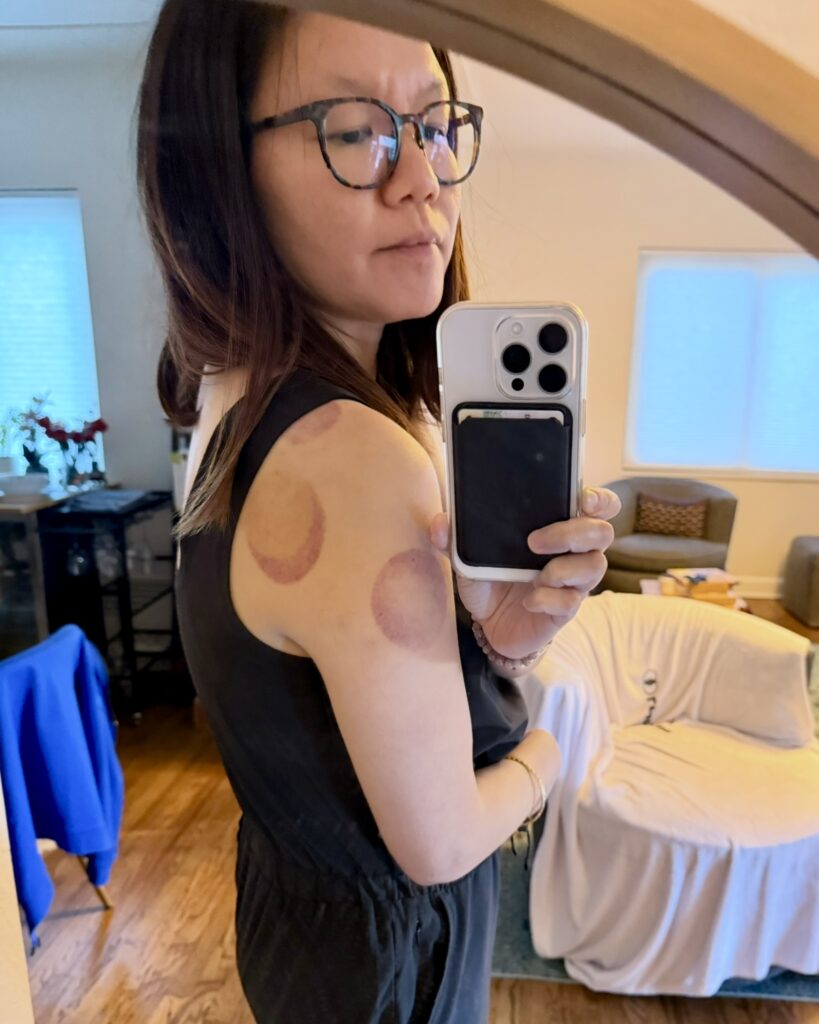
So that was the day I started physical therapy — or physio, as I’ve learned it’s called in Canada. I thought I would dread it every week, and I kinda do, but not as much as I thought. Celina has a lot to do with that. She’s somewhere in her thirties, funny, easy to talk to — the kind of person you’d want to get a drink with if she weren’t currently gripping your arm like a lever (affectionate). A big chunk of every session now is just her moving my arm for me while I lie there on the table doing nothing, reading the skeletal and muscular poster on the wall, feeling my own limb get pushed somewhere it doesn’t really want to go. All this while she pokes me really hard in the pec muscle. It doesn’t feel nice at all. Another chunk of every session is now dedicated to cupping therapy — she sticks a bunch of suction cups on and around my shoulder and I do some light stretching with them on. They don’t feel very nice either, and they create skin bruises like a mother. But after two months, I’ve gotten used to it. It is a strange thing to get used to, “therapeutic pain”, as she calls it, or someone else’s hands deciding how far your arm goes today. I have spent my whole life being the one who does the reaching.
i call this my pepperoni pizza era
I’m now about two months into physio, and my range of motion is up about 30 degrees from the day I walked in, which sounds impressive until you remember what my baseline was. It wasn’t very high. I was struggling to move it at all, actually. And I now know what the different muscles in my arm are called and which is which. I learned because I had to tell Celina that the aches are radiating down my deltoid vs. my bicep.
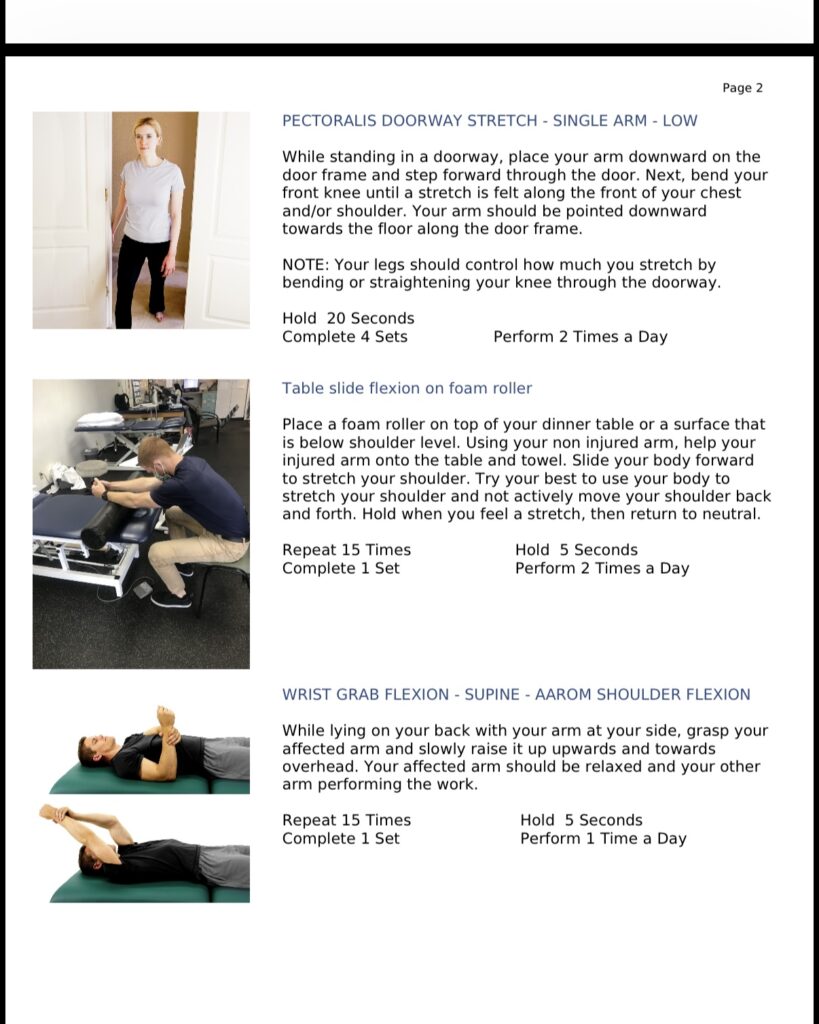
The daily grind of physio is awful. It’s not The Worst, but it’s still stupid. I lovingly refer to my at-home exercises as “these fuckass PT exercises”. I have pages of exercises — pendulum swings, wall walks, elastic band rows, something called “table slide flexion on foam roller”… the list goes on. I do as much as I can / remember to each day, including the one exercise I have fully blocked from memory because I hate it so much. But the doorway stretch has become involuntary. I cannot walk through a doorway anymore without pausing to think “should I stretch now?” and often lean my hand on against the frame and get one rep in. I’ve become a person who stretches in doorways. Ick.
page 2 of 6(!!!) of these fuckass exercises
The funny thing is: I think I’d actually be in less pain right now if I’d just left it alone. Left frozen, my shoulder wouldn’t ache the way it does most days now. It would just be stuck. Unbothered in its little frozen state. The work of unfreezing it is what hurts. Progress, in this case, feels almost exactly like the thing it’s supposed to be fixing — which feels a little too on the nose for a year that was supposed to be about resting, not pushing through pain to get somewhere. Apparently my stupid shoulder didn’t get that memo.
I’m impatient about it. Two months a weekly physio appointment and these fuckass exercises, on top of however many weeks of the frozenness just existing before that, and the arm still won’t reach behind my back the way it needs to. Thankfully I have a set of bras that just go over my head like a sports bra, with no clasp required. I don’t have a timeline for when I’ll get my full range of motion back. Celina doesn’t really give me one either. She even told me that we’ll do all we can, but there is a chance my body will just stay angry anyway. Great. Reassuring. But I need to try, because being stuck (and an even worse kind of stuck) for two years is unacceptable.
I know I could end this with a tidy little bow — 30 degrees became 60, 60 became full range, the moral of the story is patience. I think the moral of the story is still patience and annoyingly hard work, but I don’t know yet if it will pay off.
What I do know for sure is that I have a shoulder that is very slowly getting better, and is not getting worse (yay!), but one that hurts most days in a way that means something is actually happening in there.
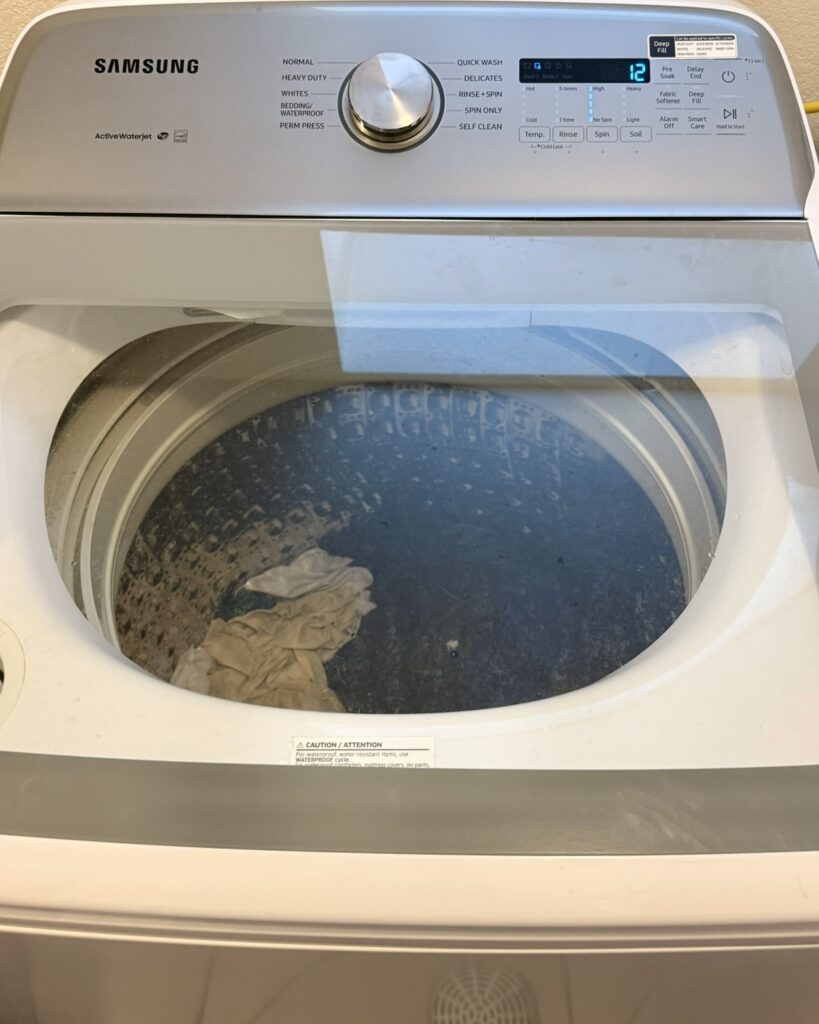
Our washing machine was having issues this past weekend, and I was in the laundry room babysitting it and threatening it. It kept filling and refilling with water, over and over again, because it sensed it was unbalanced (it was not, but the sensor thought so), and for some reason the solution to that was to waste gallons of water. Reddit and YouTube are my favorite schools — with way different faculty, but teachers nonetheless — and the best course of action was probably to replace our Samsung washer. Fine. We didn’t like these appliances anyway; they just came with the house and were still relatively new.
I started to research new washers and dryers, and I don’t know if it’s the model numbers that are just seemingly random strings of letters and numbers, or the inability to easily distinguish the difference between models, or the fact that I don’t really care about any of the features other than I need them to wash and dry my clothes without any fucking issues… but my brain short circuited and I had to outsource the research and decision to the husband. He had who knows how many tabs open comparing spin speeds and I had zero opinions and a low simmering rage, which feels like a fair division of labor at this point in my life. Bless him.
i was going to take a hammer to this piece of crap
Is it just me, or is everyone else being mentally assaulted by everything that exists in day-to-day life?
The emails, the Slacks, the texts, the phone notifications, the apps (yes, even our dear Substack), the noise, the subscriptions, the watch list, the bills, the meal planning, the shopping, the cooking, the cleaning, the laundry, the countless other household chores, the medical appointments, the social planning, the social outings, the hobbies… the resting??? How is even rest and relaxation kind of stressful? Yes, I had a massage recently, but I had to schedule it and fill out paperwork?
I cannot handle anything else. Enough is enough.
I also realized I cannot handle any new information at work. Not about GTM processes, not about CRMs, not about AI, not about my clients, nothing. I cannot effectively learn anything new unless I really want to learn it. And honestly, I don’t really want to learn about anything that doesn’t bring me joy. Salesforce certainly does not bring me joy. I don’t think it brings anyone joy. Other than Marc Benioff, maybe? Though I would love to see him use his company’s product. If you work there and can make this livestream happen, I’d watch it.
I had to log into my 401k account today to check something, and having to find and then change my password nearly broke me.
a big pour for big feelings
I don’t know if it’s old age — lol, she says, at age 39, her own mother telling her “you’re still a puppy!” — or ADHD or the state of the world or spending 18 glorious months not working full time for The Man. But I’m tired. Some days, exhausted.
This cannot be the same mind and body that endured — nay, aced — college-level courses. This cannot be the same mind and body that wrote 10 page essays the evening before they were due, without even reading the book. This cannot be the same spirit that wanted to climb the corporate ladder because I had something to prove. This cannot be the same person who had ambition. This cannot be the same person who wanted to lifemaxx or whatever the kids are saying these days.
I. Am. Tired.
I fantasize about quitting my job and going off grid into the forest. (And then I realize I like electricity and running water and the internet too much, so the forest fantasy is immediately squashed.)
The washer is still there. It was filling and refilling for a few cycles, and I figured out that if I reduced the spin speed, it would at least complete the full cycle, even if my clothes were still way damper than I’d like.
Am I… the washer? Am I just short circuiting? Am I just doing the same thing over and over again because that’s all I can do right now? Oh god.
I’m not going to end this piece by telling you I started waking up at 5am, or blocked my calendar on Fridays, or found the one productivity system that fixed it. I didn’t. I’m still tired. The emails still come. The washer still runs… for now, until its replacement arrives next week.
But I said it out loud, which is… something.
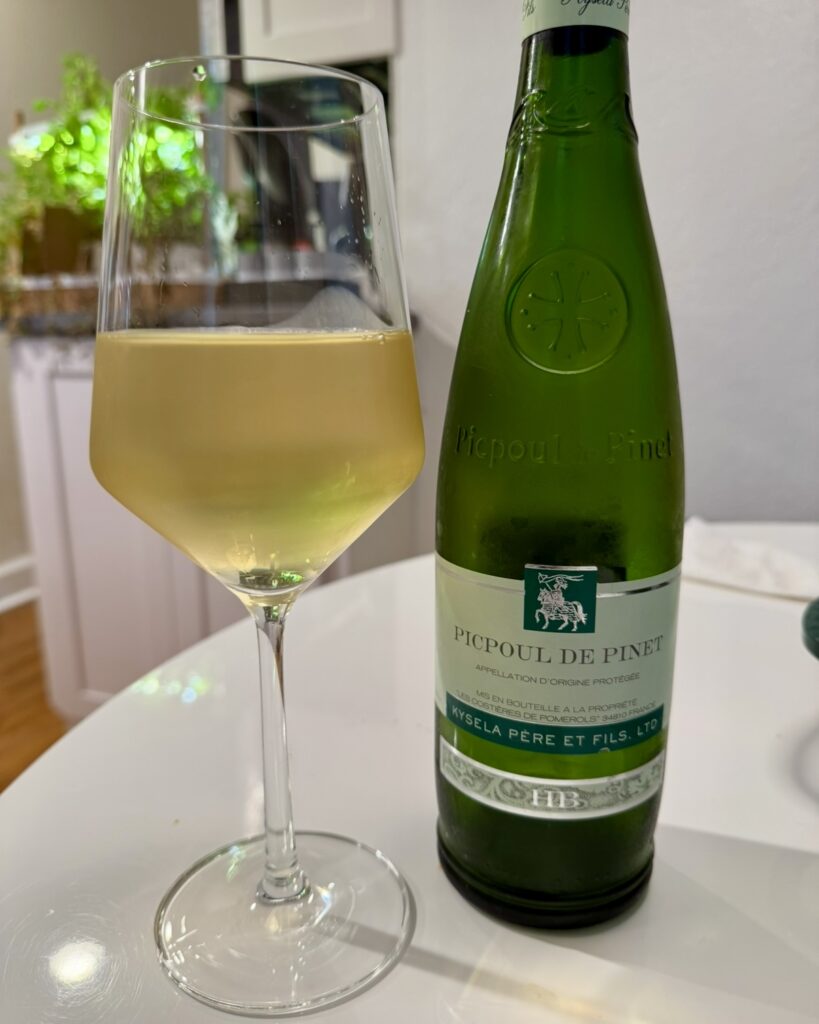
Enough is enough. Gimme a glass of wine to take the edge off, at least.
A 500-year-old word for something I’ve been doing since I was 12
There’s an art, architecture, design, and photography bookstore nearby that I adore. It’s a curated collection of interesting things, run by an interesting man. Ross is a creative, who used to work in tech, and now runs a bookstore. Talk about living the dream.
Anyway, we often pop in if we’re walking by, just to chat. And because he loves saying hi to Kona.
During one of those random pop-in conversations, I think we were talking about Italian fashion — or maybe just Italy, or maybe just fashion — and he asked if I was familiar with the concept of sprezzatura.
“Can you spell that?”
Sprezzatura is the art of making something effortful look effortless. Coined in the 1500s, it was originally about how a courtier should dress: thrown together, a little undone, like you couldn’t be bothered, while secretly having agonized over every single thread. The classic move is the bottom button of a suit jacket, left undone on purpose, because doing it up reads as trying too hard.
sprezzatura or just throwing on comfy clothes before a flight? you’ll never know
I recognized it before I went home and researched it to understand it. As Ross was describing sprezzatura, my spiritual bottom button came undone.
I realized I did this constantly in school. I was a good student. Admittedly, a lot of it was because “school” came naturally to me. But there were times I would really study, flashcards, the whole shebang, and then act completely unbothered about the grade, like it had just happened to me. Like the A was something that just happened rather than something I built. If someone asked how much I’d studied, I’d say something like “eh, a little,” which was a lie of proportion if not of fact. I just needed you to think I hadn’t. I needed you to think I wasn’t a try-hard.
I’ve spent a while trying to figure out why. The easy answer is that trying hard and failing is humiliating in a way that not trying and failing isn’t. If you didn’t really try, the failure doesn’t mean anything about you. But I didn’t fail. I got the A. And I still couldn’t let anyone watch me earn it…?
Which brings me to Substack, and the fact that I’m… kinda doing this to you right now.
I write these essays and then I go back and sometimes unpolish them. I polish some things, and deliberately unpolish others. I like it when my voice comes out in my writing, like you can imagine me actually saying these words to you. If a sentence sounds too clean, too composed, like I sat down and crafted it on purpose, sometimes I’ll rough it up. Break it into fragments (not gonna lie, I hate that AI writing loves sentence fragments. That’s how I write! Stop thinking I’m AI!). I’ll throw in a “lol” or a parenthetical that undercuts whatever I just said before it gets too sincere (see previous sentence. And this one). I want it to read like I’m sitting with you and talking to you, not performing for you — but sometimes the talking-to-you voice is itself a performance, workshopped and revised until it sounds unworkshopped. Buttoned all the way up, then one button undone right before you see it. A few well-placed wrinkles so you know I’m a human being living in these clothes.
Social media is just this, run through an amplifier. The #nofilter caption on the photo that took 20 takes. The #iwokeuplikethis selfie that shows perfectly unkempt hair and the golden hour light beaming into a dreamy bedroom. The vulnerable, off-the-cuff caption that got written, deleted, and rewritten five times to find the version of off-the-cuff that read best. We’re all courtiers now, dressing for an audience of strangers, and the whole game is convincing them we didn’t dress for anyone at all.
I wanted to think sprezzatura was the opposite of perfectionism — one is trying so hard it shows, the other is trying so hard it doesn’t. But I don’t think that’s right. I think they’re the same fear wearing different outfits. The perfectionist is scared of what happens if she tries and it’s not good enough. The sprezzatura girl is scared of the exact same thing, she’s just found a way to protect herself from it in advance. She’s nonchalant. If no one knows you tried, no one can tell you the trying wasn’t enough.
I don’t have a fix, or a conclusion. I’m not going to tell you I’ve started leaving my effort visible, announcing how much I’m trying, posting all 20 takes. I am going to tell you this essay feels very meta in that I’m actually not going back to rough it up a bit.
What I do know is that the word followed me home from that bookstore for a reason. It named something I’d been doing since I was 12, something I’m doing in this sentence, probably, if I’m honest, which… see? There. I almost edited that.
There’s no “jump to recipe” button on this one, sorry.
Lamb keema — concisely: ground lamb with spices — is often served with pasta in my house. Not naan, not rice. Pasta. Ideally a short, tube-shaped pasta, as is appropriate for a ragu. And keema could be classified as a ragu (cue angry nonnas everywhere).
It’s spiced ground meat over pasta, and it’s delicious, and it makes complete sense if you don’t spend too much time thinking about whether it’s supposed to.
I had it for the first time in my in-laws’ house in New Jersey, made by Rita Auntie — who is actually R’s aunt, and not even his aunt by blood or even by marriage, but by the kind of decades-long friendship with his parents that makes those distinctions feel silly. An auntie, even not by actual familial relation, is still an auntie. In many cases, those “aunties” are closer than family.
Anyway.
She and Uncle were around that season to help my father-in-law out with cooking and housework — all the things my mother-in-law did — and to keep him company during a tough time. As real family does. My mother-in-law’s cancer was back, after five years in remission, and it had taken a turn for the worse. She was at least out of the hospital and moved to a physical rehab center half a mile down the road from the house. It was one of those periods where people show up and either bring or make for everyone because it’s the thing that can be done.
One night, dinner was keema pasta. Auntie told us she started making keema with pasta because her grandkids preferred pasta over rice. How American! But she learned to love it too. And what was there not to love? I had two helpings… possibly three.
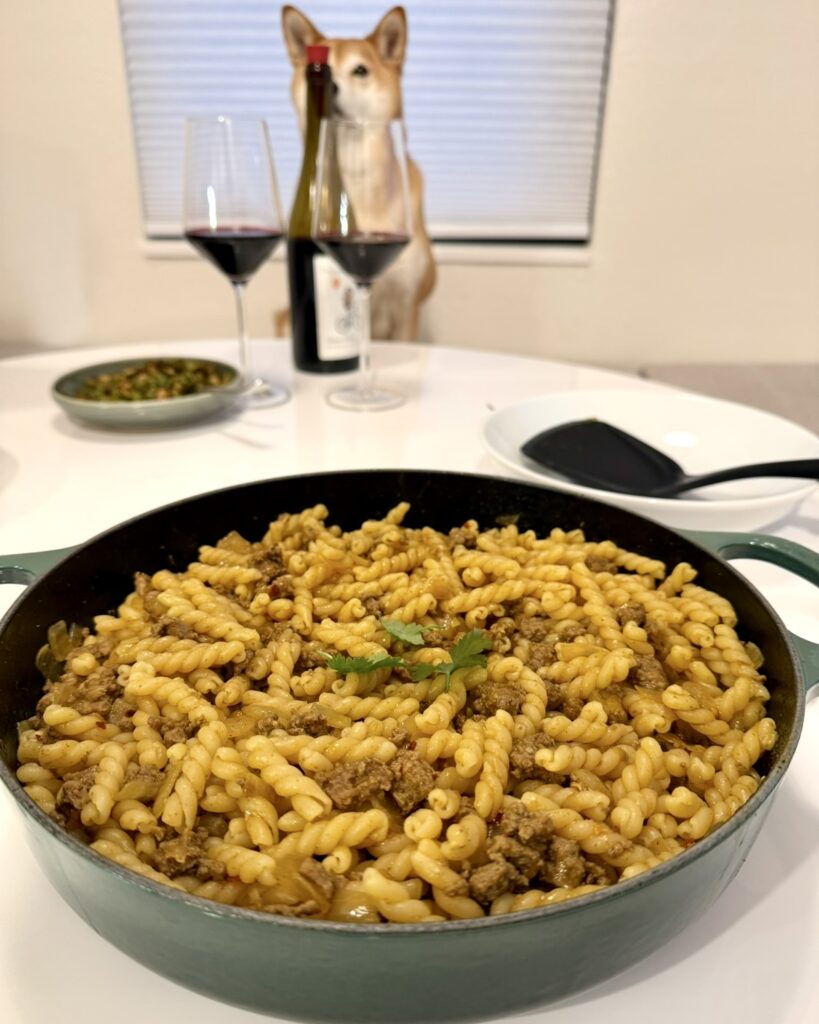
pairing keema pasta with wine probably isn’t traditional either
I wasn’t in the kitchen when she made dinner that night, so I asked her for a recipe, because I needed to know how to recreate something that delicious.
“Do you know how to make chicken curry?”
I said yes — because my mother-in-law had taught me.
“Ok,” Auntie said. “It’s the same thing, except with ground lamb. Onion, garlic, ginger, masala, meat, simmer, garam masala to finish.”
That was the lesson. It’s been a few years, so I don’t remember, but she might not have listed the ingredients, actually. She might have just said it’s the same as chicken curry. lol.
I think about that “lesson” every time I make keema. There’s something in the geometry of it that I find so sweet and so… mom-like: Auntie teaching me a recipe not by giving me a recipe, but by pointing at knowledge my mother-in-law had already given me. In my mother-in-law’s kitchen, while my mother-in-law wasn’t there to know it was happening. Her teaching was not specific but still useful, and tied to a lesson I had actually learned step by step. My mother-in-law taught me chicken curry. Auntie taught me that chicken curry was the base for other things. That unlocked something in my brain and I realized I know how to cook so many more things than I thought.
The pasta thing is its own lesson. Keema is keema, and then you put it over whatever makes sense for your table. Auntie’s grandkids wanted pasta, so pasta it is. No “authenticity” policing (you know how I feel about “authenticity”), no announcement that they were eating “fusion”. The kids like pasta, the keema goes on pasta, it’s delicious on pasta. What else do you need to know?
I’ve experimented with different pasta shapes. I’ve gone back to rice, just to try it. And I can say with confidence that I like it more on pasta! It doesn’t really matter what kind. What can I say? I’m a noodle girl through and through.
Recipes never travel as themselves. They travel as what someone showed you, in someone’s kitchen, on a specific day. There’s context. You can follow a recipe from a cookbook and make it perfectly and it will taste delicious but won’t feel like anything. But if someone looks at you across the kitchen counter and tells you, “You already know how to do this,” that hits different. I could have learned the recipe from any YouTube video. But I learned it from Rita Auntie, in my mother-in-law’s kitchen, during a time when we were all looking for joy and peace and normalcy. And I look back and realize how lucky we were to have that time together, despite the less-than-ideal circumstances.
The keema is a way of keeping the thread with Auntie (and Uncle) open — every time we text her that we made it, it feels like a report back. A shared experience we can all point back to. It’s saying, “I still have this gift you gave us, and we use it all the time, thank you.”
I now want to share this gift with you. I wrote down the recipe for chicken curry after countless watches of a video of my mother-in-law making it. I adapted it to read like a recipe anyone can read, and that I now follow every time.
—
Lamb keema pasta
—
Rita Auntie’s recipe
Equipment
Stockpot for making pasta
Medium/large pan or pot with lid for making keema
Ingredients
In the same bowl (Bowl 1: aromatics and tomatoes bowl):
1 heaping tsp minced ginger
1 heaping tsp minced garlic
2 Roma tomatoes, diced
1 dried bay leaf
In the same bowl (Bowl 2: spice bowl):
1 tsp ground cumin
1 tsp ground coriander
1 tsp ground turmeric
½ tsp ground black pepper
Other ingredients:
2 TBSP cooking oil
1 lb pasta (I personally like this with tube-shaped pastas, like penne or rigatoni, but you do you!)
1 medium onion, diced
1 lb ground lamb (can sub with chicken, turkey, pork, beef)
1 tsp Indian chili powder (or cayenne powder. NOT American chili powder because that’s for making chili)
1 cup water
½ tsp garam masala
cilantro leaves (optional, for garnish)
Instructions
Start boiling water in your preferred pasta-making pot, and salt it generously. When the water boils, turn down the heat, keep the lid on, and save your hot water for later. We’ll cook the pasta last.
In the meantime, heat 2 TBSP oil in a saute pan on medium heat.
Add onion and cook until soft and translucent, about 5 minutes.
Add Bowl 1 (aromatics and tomatoes: ginger, garlic, bay leaf, tomatoes) and cook for a few minutes, until aromatic and the tomatoes are cooked down a bit. Then add Bowl 2 (spice bowl: cumin, coriander, turmeric, and black pepper) and mix together. Cook for another few minutes, until the raw smell of spices disappears. If spices start to stick, add a few drops of water so they don’t burn.
Add the ground meat and break it apart so it’s extra minced. Sprinkle on some salt to taste (start with about 1 tsp). Add some chili powder for heat (optional). Cook the meat for 5-7 minutes on medium heat, continuing to break it apart as it cooks so that there are no large lumps.
Add 1 cup of water to deglaze and make sauce for simmering (add more liquid if you want more gravy). Add garam masala to pan and cover, and simmer for 10-15 minutes (about the time it takes to cook pasta!). Skim off any fat that floats to the top, if desired.
While the keema is simmering, cook your pasta (remember that pasta water you already boiled?) and drain it. Reserve about a half cup of pasta water on the side.
Taste the keema gravy and add more salt or chili powder to taste. Add it to the drained pasta, and add a few TBSP of reserved pasta water if it needs to be loosened up.
Garnish with cilantro leaves and enjoy! Maybe even grate some Parmesan cheese on top…
Reps, free throws, and the DMs I still haven’t sent
A few months ago, a chat notification popped up. A writer I’d been following — someone whose essays I’d read and mentally bookmarked (because I always actually bookmark them and forget bookmarks exist), someone I’d been meaning to reach out to, someone I wish I were friends with in real life — had sent me a note first. Warm, friendly, casual, real.
hi!!! I just want to say I think you’re great and am glad we are connected. If you ever want to *gasp* chat face to face, I’d love to do a little virtual coffee chat (as much as I hate the term, it works here!)
I typed back immediately. omg you are so sweet! i’m so glad we found each other here — obviously i think you’re great too!
Sent it, smiled, and felt weird about it. Not because I thought the interaction was weird or that I was weird. But because I had been meaning to send a message first. For months.
Then we had our little coffee chat, and we talked about just this, but in a slightly different context: Everything you do can be a rep. Like free throws (she says, never having practiced free throws because lol sports?, but work with me here). It came up when we were talking about networking, about how networking (barf) is not something that comes naturally to either of us. But what if we treated it like a muscle we have to train? When you want to get better at something, you practice it — not in some abstract, aspirational way, but literally, repeatedly, until the motion stops feeling like a forced motion.
Shooting my shot with people I don’t know yet? These are not Amanda’s Natural Gifts. These are, apparently, reps I have to do. The good news is I know this works. I have evidence.
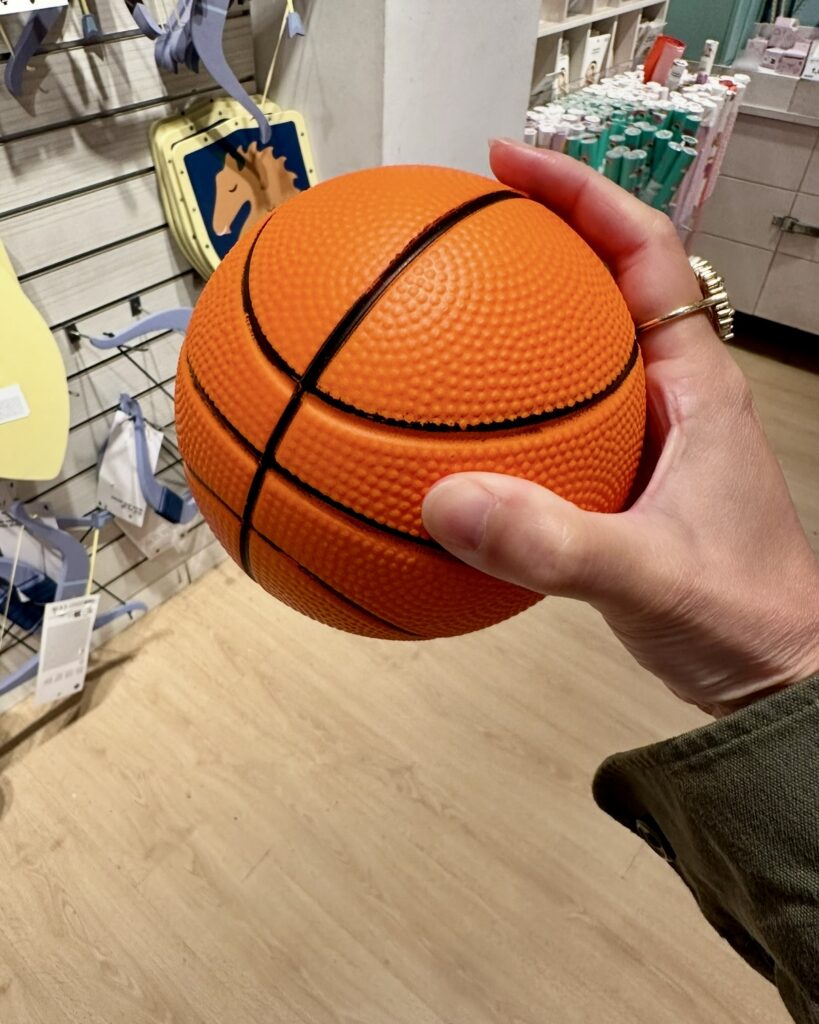
my tiny hands can’t hold a normal sized basketball. why would i be good at shooting free throws
Work presentations used to make me want to crawl out of my own skin (ok, they still do). I hated them. Despised them. The nerves, the feeling of being judged by strangers, all of it. Then I kept doing these godforsaken presentations because the job required it, and eventually that miserable repetition became slightly more bearable. The reps compounded. I got better. I got — not comfortable exactly, but capable. “Fake it til you make it” until you actually make it.
I started writing on Substack about a year ago, just to get my thoughts out. Somewhere, anywhere, it didn’t even matter if anyone read them. What kept me here was the people — other writers, readers who’d left comments, followers who’ve engaged in banter on Notes. I’ve thought: I should message them. I should reach out.
I should do the rep.
… I did not do the rep.
I’ve thought about it. Then I’ve talked myself out of them on the grounds that they might think I was weird, or too much, or too eager, or, I don’t know, something. Insert any insecurity here. The fear was never fully formed enough to argue with. But it was there.
In the meantime, those exact people started reaching out to me.
And it’s been genuinely lovely! And also a little humiliating, if only to myself. Because every time someone beats me to it, I say something like “I’ve been meaning to reach out!” and have it be true, which is somehow worse than if it were a polite lie.
I am standing at the free throw line holding the ball, having watched five other people make the shot, and I am still just standing here.
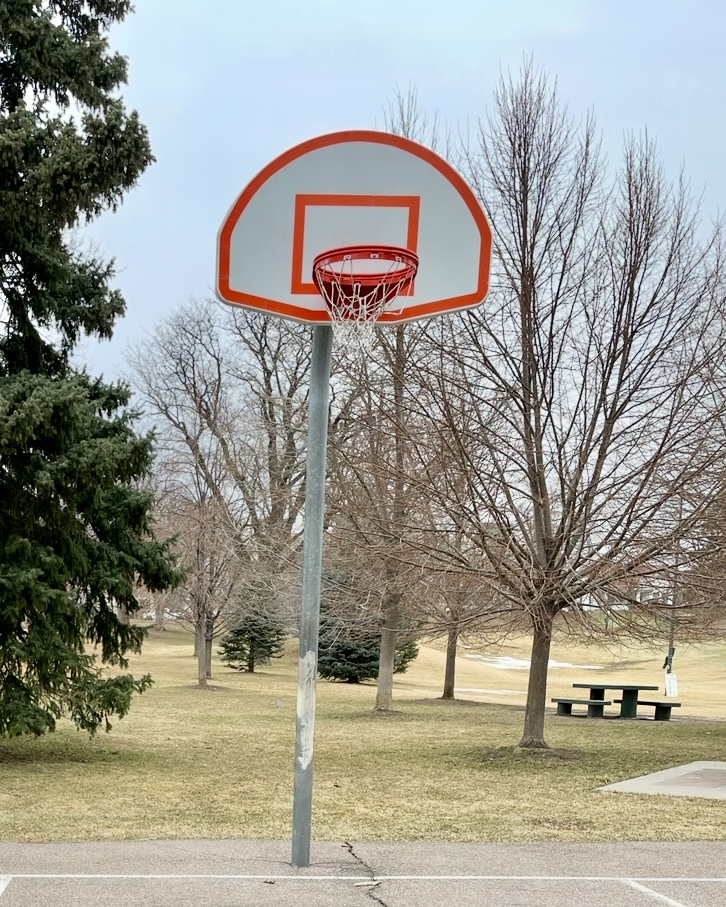
the basketball hoop at the park near my old house
With kickoff presentations, what’s at stake is competence. They might think I’m bad at my job. Fine, I’ll do more reps, I’ll get better, there’s a path from here to not-terrible. Sending a note to a writer I’ve been reading for months, talking to a reader like they’re already my friend — that’s not competence on the line. There’s no rubric, no feedback form, no way to tell if it landed. It’s me saying “I see you and I’d like you to see me too, and can we be friends?”, and waiting to find out if that reads as warm and lovely or as a lot. Whether I seem like someone they’d want to know, or someone who sends slightly too-earnest DMs to strangers on the internet.
That is, it turns out, a much scarier rep. Because failing at a presentation means I need more practice. Failing at this means — I don’t know. Something worse.
I haven’t sent the DMs to everyone I’ve wanted to “meet”. Not yet.
But I’m writing this, which is something. Putting the undone rep on the page, on Substack, where the exact people I haven’t reached out to might read it, lol. Which is either a very roundabout way of doing the rep, or it’s just another way of standing at the line. Maybe that counts, maybe this is the practice.
Or maybe I’ll finish this essay, hit publish, and then finally just send the message. (I’ve been meaning to.)
Somewhere between being coworkers and being us, I ended up with keys to an apartment on the Upper West Side.
We met at work. We were friends who ate lunch together most days for about two years, and then we were more than that. That’s the origin story. There was no first date I can point to. We just became.
June 19 was our dating anniversary. Fifteen years. That’s nearly 40 percent of my life. I did the math a few times to make sure, and because I’m bad at math.
the 620 sq ft apartment i found myself with keys to. lol at my timbs.
I don’t really know how to mark a dating anniversary when you don’t remember dating. We didn’t do the thing where you go on dates. There was no “talking” period or courtship period. We did the thing where you’re suddenly in each other’s lives so completely that the category stops applying.
The wedding anniversary in October is the one we celebrate properly. If we’re not somewhere far away, we’re at a special dinner, probably one with a tasting menu and wine pairing. The dating anniversary is more low key. We notice the date. We spend the day together — easier now that Juneteenth is a holiday — and we go out to dinner somewhere we already like. One of us says it at the table: Wow, fifteen years.
This raises a question I’ve been sitting with: is every dinner out a date night?
We go out to eat a lot (but not often enough). We love to eat. We try new places and we return to old ones and sometimes we end up somewhere because it was close and we were hungry. Is that dating? Is fifteen years of that… dating? What makes a “dinner out night” a Date Night?
I think at some point the question stops being a question. You’re not dating. You just are.
a photo from our first year together. i don’t really wear converse anymore (my old feet need more arch support now) but he still wears adidas
There’s a version of this essay where I say something about how R is my best friend and I love him to the moon and back, and I mean it, but I also don’t want to write that sentence because it sounds like a toast and this isn’t a toast. What I mean is something I genuinely don’t know how to say: I don’t remember my life without him. Not “I can’t imagine it” — I literally cannot retrieve it. He’s been there for 40 percent of my life. He was there when I finished grad school, when we both decided to pack up and move to Denver, when we traveled the world, when we got Kona, when my dad died, every time I got a new job, every time I was laid off from that job. The before-him era exists somewhere in my memory like all the times I visited Disney World as a kid. I know I was there, but I can’t really picture it.
We were friends before we were “we”. By the time we were more than that, we’d already seen each other on bad days. I already knew he annoyingly lets everyone off the elevator first, even if that means he’s standing in the way. He already knew I sing the guitar solo or other instrumental break of every song. There was no performance of a first date because we’d already skipped past it somehow.
Then keys to an apartment on the Upper West Side.
We’ve lived in about six places since then. That W 85th Street fifth-floor walkup (and our terrible landlord) is long gone from our lives. But that’s the closest thing I have to a beginning. Not a specific moment. Just: keys.
W 85th street
Fifteen years later, we go out to dinner and a show (an Iration concert, hi Kathi!) and we say the number out loud and it sounds made up. We’re not the people we were 15 years ago, not exactly. We’ve changed in ways that are hard to inventory — some of it together, some of it separately, some of it because of each other. Every version of who I’ve been in the last fifteen years had him in it.
That’s the thing worth noticing, more than the date.
(He promised me 50 years of marriage. We’ve got 40 of those years left.)
A friends’ birthday tradition, actually answered this year
I was into musicals before it was cool. I wouldn’t say I was a theater kid, but if you’ve been here a while, you know music is a core part of me.
I know how that sounds now, in the era of Hamilton and Wicked. But when I was growing up, this was not a culturally safe thing to be into. Neither was anime (Sailor Moon, Neon Genesis Evangelion, to name a few), or J-pop (Utada Hikaru, Ayumi Hamasaki) — and then K-pop (H.O.T., S.E.S.), before K-pop became mainstream in America. I was — am — an introvert with very specific taste who was not, for the record, doing the “cool girl” thing. No parties, no sports. Japanese RPGs and learning all the words of the Cinderella soundtrack. The Brandy and Whitney Houston one. The one with Paolo Montalban as the prince (iykyk).
I didn’t know then that I would look back at this girl and think she had it right all along.
—
My friends have a birthday tradition. Every year, the person celebrating answers three questions:
What from the last year are you carrying with you?
What are you leaving behind?
What are you excited about?
It started, I think, as a party game and became something more — a ritual you say out loud to the people who love you, which makes it more real than a journal entry… or a Substack post.
how dramatic would it have been if the questions were in this envelope? (it was just a birthday card)
This year, I actually thought about my answers.
—
What I’m carrying with me
Somewhere between college and learning to go out and be a person in the world, I set some things down. The way you set something down when your hands are full — you mean to come back for it, and then you forget where you put it.
I stopped gaming. I stopped watching anime. I let the K-pop comebacks happen without getting too excited about them. I stopped doing things partly because there wasn’t time, and partly because I had started running everything through a filter in a way I’d never done before. Is this a thing I’m supposed to like? Is this a thing a person my age does? I had decided — whether consciously or not — that some interests were teenage interests. Things to grow out of rather than grow with.
I was recently singing “Cool Rider” — yes, from the Grease 2 soundtrack — and imagining I was a young Michelle Pfeiffer dreaming about a bad boy on a motorcycle. And I thought “oh. I was always this girl.”
I remembered that girl with the niche taste and the strong opinions and zero interest in going to the party. She was ahead on the K-pop thing by years. But more than that, she just liked what she liked. No filter. No running it by the committee of who she was supposed to be. She trusted herself. And this year gave me that back. I’m carrying it into the next year with me.
What I’m leaving behind
Self-doubt. Took long enough. It’s a practice every day, but I’m trying my damnedest to leave it behind.
What I’m excited about
More. More of figuring out what I like, and more of trusting it once I find it. More learning the shape of my own taste. The things I keep coming back to, what I thought I wanted but actually don’t, what I wrote off and shouldn’t have. More friends, more love. More travel, always.
more rest and relaxation too. this was me waking up from an outdoor nap on my birthday.
—
Teenage me would be delighted. She’d probably also say “I told you so.”
From Lei Day to distress call in 31 days. (ok, maybe being a little dramatic)
On May Day, we hiked Diamond Head before it got hot.
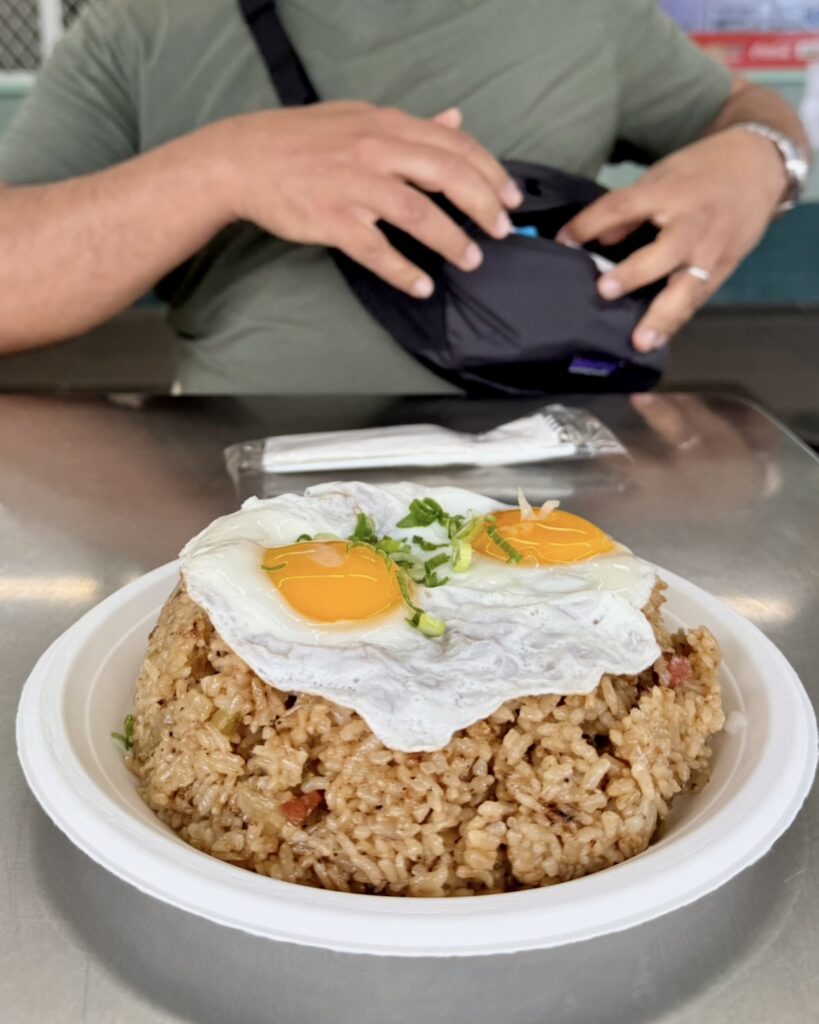
Ok, that’s not entirely true — it got hot. More like humid. But we started early enough (6am!) that the worst of it hit on the way back down, when we were already done being heroic about it. Fried rice from Rainbow Drive-In in our immediate future. Rainbow Drive-In is a plate lunch institution, the kind of place that has a line at 9am and should, and the fried rice is exactly what you want after a hike. The hike was a bit harder than we thought it was going to be, mostly because we are no longer used to humidity. But it was worth it. We’d earned it. We’d earned being in Hawaii, even without the hike.
all this for ten bucks. a perfect post-hike reward.
We were in Honolulu to reward ourselves — for surviving a half year that had featured more appointments to a retina specialist than I care to recount. (If you’re new here: my husband has had three eye surgeries since Thanksgiving. Detached retina and related issues.)
You slog through the adversity, you book the trip for as soon as you’re clear to travel, you go eat fried rice on a Friday morning on an island where it’s warm and the flowers are everywhere and it’s May Day, which in Hawaii is Lei Day, which means the whole city is doing something fun and festive.
That afternoon, we visited Shangri-La, Doris Duke’s vacation home turned museum of Islamic art, right on the water. She knew what she was doing, real estate-wise. The lusterware mihrab was the star of the show, and I could have sat in front of it all day listening to our tour guides, whose level of knowledge was giving full PhD dissertation energy.
can you imagine this being your living room
We walked Chinatown — downtown Honolulu — where everyone was having a party and a sale simultaneously, which is a combo I fully support. I was handed a glass of prosecco just for walking into a shop. We wandered into what we thought was an art gallery and turned out to be another curated home goods store. With party drinks! I was so wiped from the day that I found a vintage chair in the corner and just sat in it while R and our friends chatted up the owner. I didn’t even pretend to browse. I just sat there, in a stranger’s nice chair, in a room full of things I wasn’t buying, and it was perfect.
That evening we had dinner at Fete, which might be the best restaurant in Honolulu, which might mean I have to go back and confirm. You know, for research.
The rest of the week was like that. I was doing stuff, but I was decompressing. I know how to say it without guilt now: I was resting. On purpose.
Then I came home.
The job offer came fast — faster than I expected, which is funny because I thought I was ready, I’d been waiting for it, and yet. I wasn’t expecting the CEO’s Slack DM at 7:30am on the day I returned. I scrambled. We talked through paperwork and logistics, and then I hit the ground running the following Monday. Hit the ground running. A phrase I’d forgotten I knew how to do… which maybe should have been a warning. Oops.
doing stuff but decompressing
The first couple weeks back I kept catching myself mid-meeting, surprised I still remembered how to do this. How to context-switch. How to move with urgency. The vocabulary came back like muscle memory — syncing, aligning, circling back, let’s find time — a whole language I’d spent the majority of 2025 not speaking, and I was suddenly fluent again. I clocked more hours than I probably should have. I felt that productive exhaustion I’d almost forgotten I used to run on.
Almost forgotten. And then immediately remembered. Snapped right back into it.
What my body had to say about all of this: No.
Or more like: Hell no. It was more like a door that just stops opening. I got diagnosed with a frozen shoulder — the joint capsule tightens, mobility decreases, treatment is physical therapy a few times a week, and every day at home, until things loosen up, which takes months. Cool, cool cool. A frozen shoulder is exactly what it sounds like. I did not need it explained to me. I understood it immediately, physically, because my body was making a point.
I had been going to the pottery studio every week, often multiple times a week, for hours. It was the thing that had nothing to do with output or productivity or any of the words that used to follow me around — just clay and community and a two-hour block where I made things that were sometimes beautiful and sometimes fell apart. Unfortunately, that time is now dedicated to physical therapy (or physio, as it’s known in Canada and now in my lexicon). I need the physio more than the studio needs me. I know this, but it doesn’t make the absence smaller.
All things considered, I’m doing ok. The job is ok. My shoulder will thaw. I’ll get back to the studio eventually.
But not gonna lie, May hit me like a truck. A truck wearing a lei.
I miss Hawaii. I need another trip to reward me for enduring the month of May.